An Ode to Cold Outreach

From https://odetocoldoutreach.notion.site/An-Ode-to-Cold-Outreach

Hi fellow founders! đź‘‹

Yuliya Bel here. Fundraising is not easy. It takes an incredible amount of time (at least 2-4 months), energy (this will be your full time job) and nuance to do it well. To increase your chances of getting to term sheet – you have to 1) build a network of founders, angels, investors and operators and 2) run a really good process.

In the spirit of founders helping founders, particularly those who are underrepresented and under-networked, I’ve put together a guide and list of investors who are open to strategic cold outreach from founders who are in the process of raising.

For feedback, DMs open: @YBelyayeva.

đź‘‹ Investors join the list: here

đź§  To successfully use the No-Warm-Intro-Required list

How to be thoroughly strategic in your outreach:

  • Do your homework: does this investor invest in your vertical, at your stage, and appropriate check size
  • Make it tailored: why is this investor interesting (ex: investor’s particular value add, previous investments, reference their content/blog post)?
  • Keep it short and human
  • Triple check spelling and names
  • Don’t spam! Remember that this is the start of a possibly 7-10 year relationship, so start it with your best foot forward.

Hustle Fund’s Elizabeth Yin wrote an amazing post on how to cold-email investors.

🛎 Before you dive in:

Please note: This list is meant to bolster, not completely replace, a strategic and well-run fundraising process.

Although many investors here have invested in start-ups without a former introduction, the fundraising process tends to be quicker and smoother if you do an initial search and see if you have any mutual connections to make the intro or create some buzz around you first.

Not everyone comes with a network — this is one of the reasons that underrepresented factors continue to not have access to capital. These steps will help you mitigate challenges.

How to increase odds of getting a meeting? Run through this checklist:

  • [ ] Target list. Put together a list of ~100 most relevant investors for your start-up.
  • [ ] Research if anyone on your LinkedIn, Twitter, former colleagues, college alumni has a connection to the investor or the firm. If you have a few connections, think through which person’s endorsement would be the most enthusiastic and strongest.
  • [ ] Make a short and human blurb about your company, milestones/North Star KPIs, your raise progress that can be easily forwarded.
  • [ ] Build a network of founders. Founders are allies and friends who have been through the wringer to know how tough the journey is. Besides support, they can help with putting in a good word to investors as they themselves get funded.
    • You should also connect with founders of portfolio companies of investors from your list. They are the #1 best intro you can get.
  • [ ] Join bootcamps, accelerators, pitch competitions. Some are equity- and capital-free, and they provide a scalable way to grow a network.
  • [ ] Build in public on Twitter. This is easily one of the most hackable – but time intensive – processes to build a community, reputation and get on investors’ radar.
  • [ ] Build proof points and articulate narrative well. Much has been written about when it is the best time to raise and how to get investors’ attention. It really boils down to when you can present a clear case for why your idea and your team are fundable.

    If you’re a first time founder, you’ll need a larger data set of proof points to de-risk the investment for investors. These include a strong combination of: KPIs around traction, retention, milestones, user testimonials, first hires, early partnerships, buzz on social, authentic loyalty from community, depth of discovery. Add a narrative to your proof point data set and you are going to be in a strong shape for the raise.

  • [ ] If you’re still have gaps in reaching investors from your target list, plug in the No-Warm-Intro-Required list using the success tips in the first section👇 **

🤠 With any feedback or thoughts, please shoot me a DM @ybelyayeva and pass it forward!

đź‘‹ Investors join the list: here

No-warm-intro-required investor list

👉 The investor spreadsheet is here.

A general breakdown:

  • 160+ investors
  • Top 5 verticals: B2B, Productivity/Future of Work, Enterprise Software, SaaS, AI/ML
  • Up-and-coming verticals: Focus on no code, Clean energy/Greentech, Foodtech, Edtech, Media/Adtech
  • Start-up stage breakdown (overlap from multi-stage investors):
    • Early stage: Seed stage (80%), Pre-seed (67%), First check (36%)
    • Growth stage: Series A (57%), Series B (21%)
    • Late stage: Series C (10%), IPO (4%)
  • Almost half lead rounds
  • Almost half invested from strategic cold outreach

With investors from:

👉 If you are an institutional or angel investor who is open to additional dealflow or another way to build a more thriving and transparent tech ecosystem, please complete this form to join.

Additional Resources*

*If you’d like to include a resource, DM me.

Spaced out by CB Insights

From https://research.cbinsights.com/fintech-100

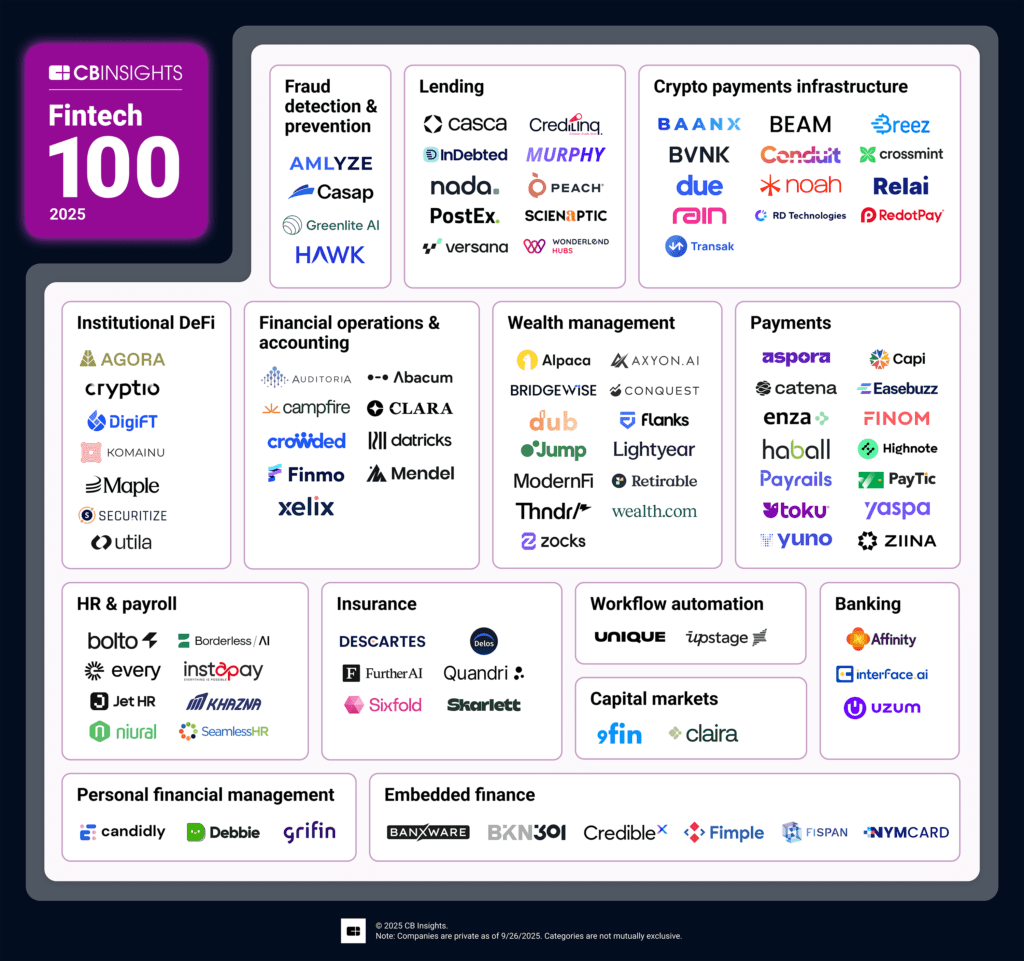
Hot: Fintech 100

CB Insights is launching the 8th annual Fintech 100 list — a ranking of the world’s top emerging fintech companies.

This year’s cohort at a glance:

  • 26 countries represented
  • Average Mosaic score of 775 (top 2% of private companies)
  • 61% average headcount growth over the past year

We selected the winners from over 15K companies using deal activity, industry partnerships, investor strength, hiring momentum, and CB Insights’ predictive scores for success and commercial traction.

See the full Fintech 100 2025 list here to dive deeper.

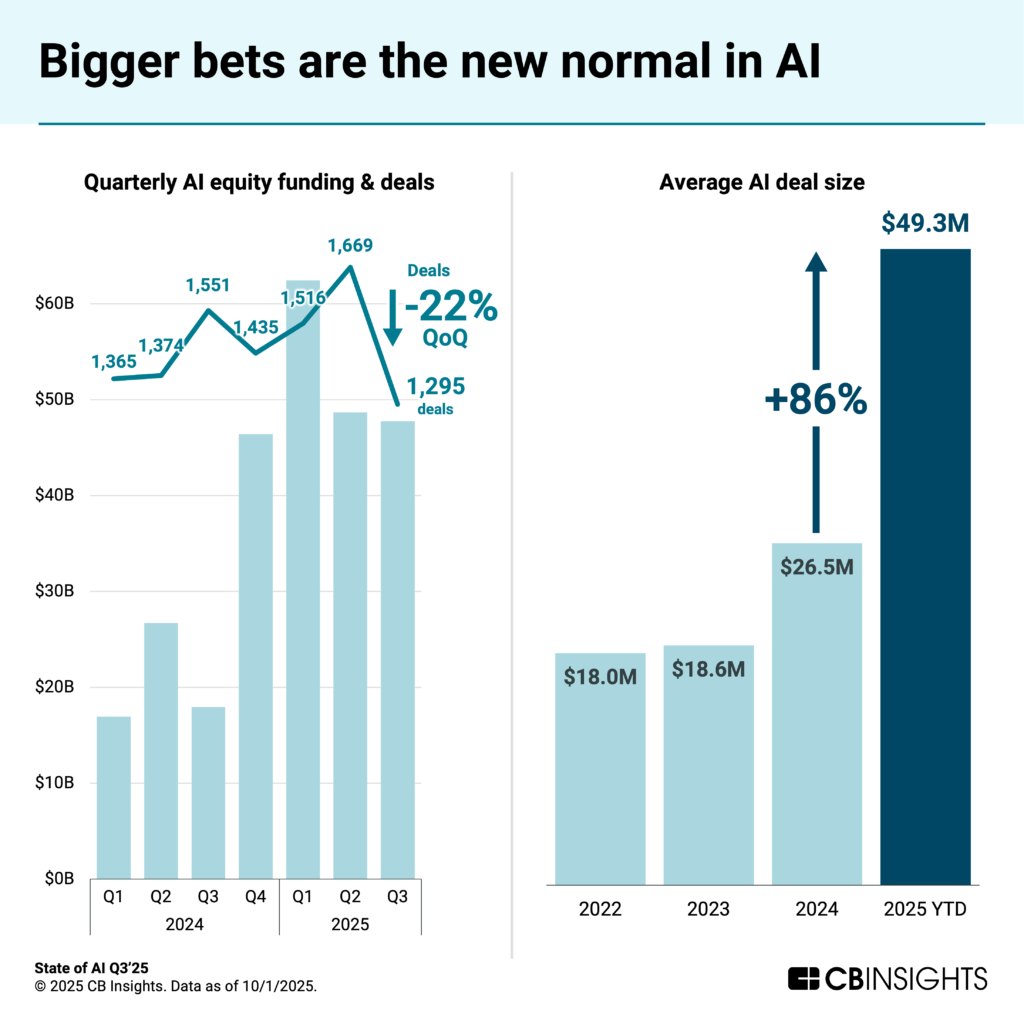
Not: Q3’25 AI deal count

Deals were down 22% QoQ, but funding remained above $45B for the fourth consecutive quarter.

You can do the math: AI rounds are getting even bigger.

The average deal size in 2025 YTD is $49.3M — up 86% from 2024.

Investors are funneling capital into fewer, larger bets, driven by the massive infrastructure costs.

In Q3’25, the top 3 $1B+ rounds went to LLM developers, reflecting the high cost of frontier model development:

  • Anthropic ($13B, Series F)
  • OpenAI ($8.3B, PE)
  • Mistral AI ($1.5B, Series C)

See the full breakdown of AI funding trends in our State of AI Q3’25 report.

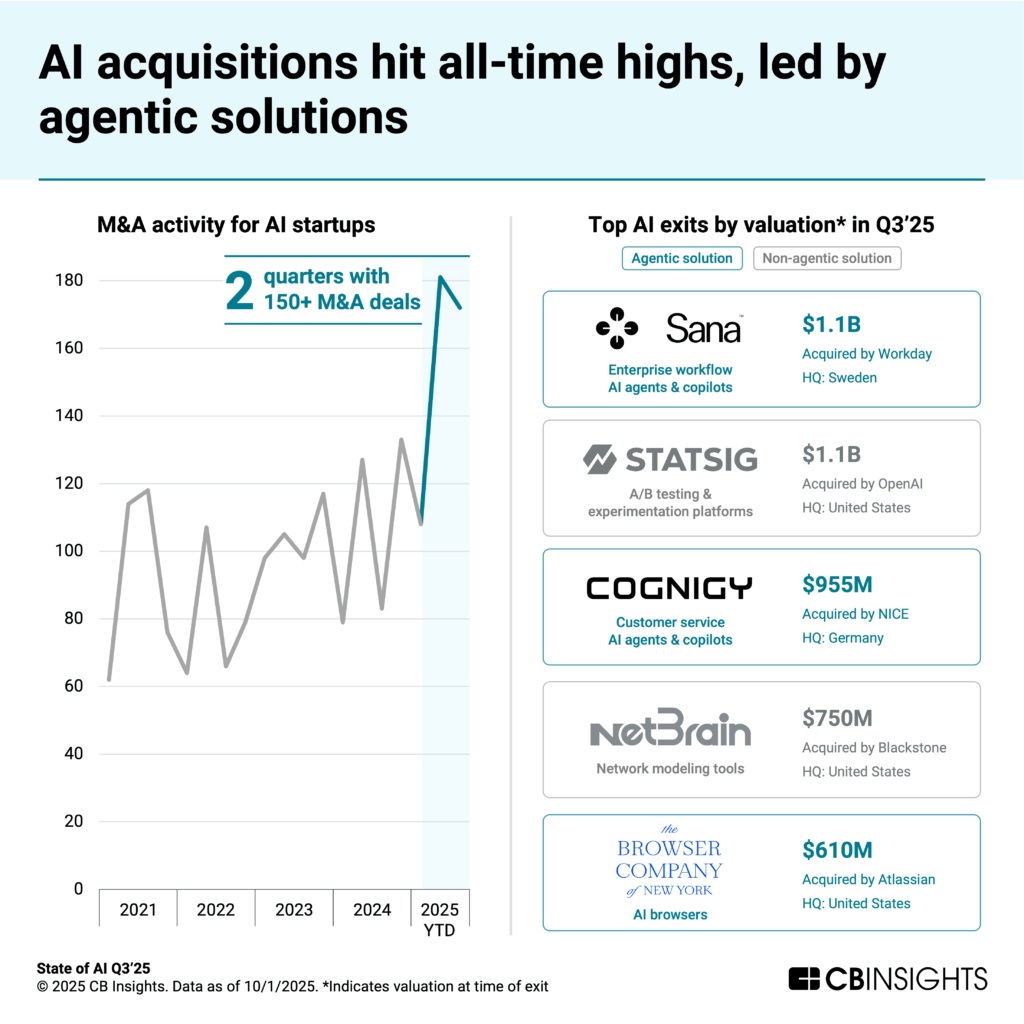
Hot: AI agent exits

Q3’25 marks the second highest quarter on record for AI startup M&A (172 deals).

Three of the top 5 exits in the quarter were related to AI agents:

  • Workday acquired Sana Labs, a company focused on enterprise workflows, for $1.1B
  • NiCE acquired customer support startup Cognigy for $955M
  • Atlassian acquired The Browser Company, the maker of the Arc and Dia AI browsers, for $610M

Learn more in our State of AI Q3’25 report.

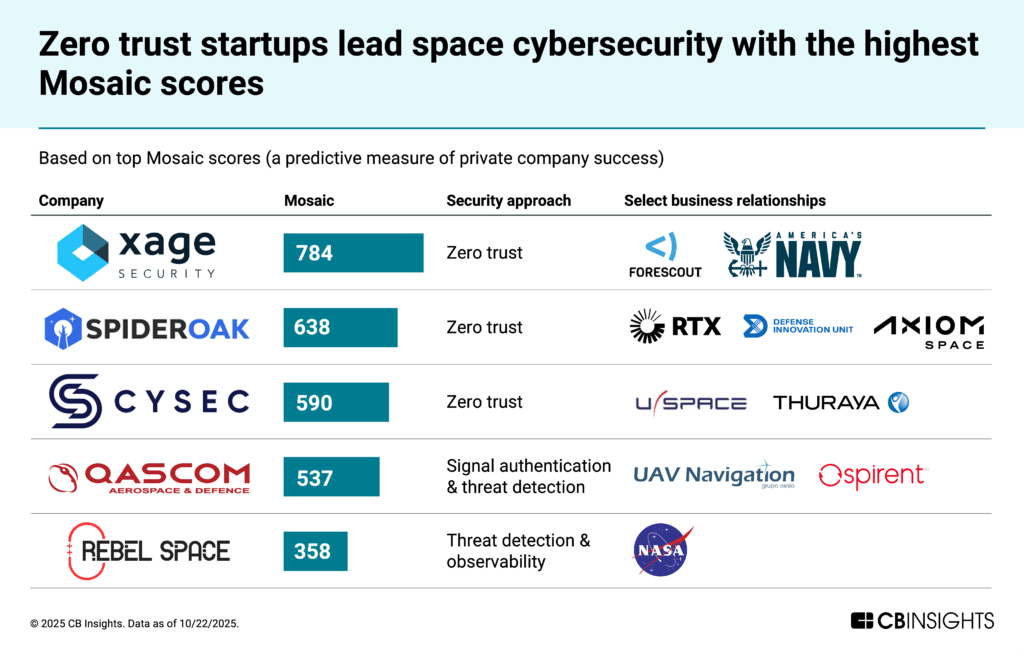
Not: Space cyberattacks

SpaceX is set to build a $2B satellite constellation for Trump’s Golden Dome missile defense system.

As space infrastructure is evolving into critical commercial applications, space cybersecurity is now a necessary defense.

Using our proprietary Mosaic score — a predictive measure of private company health and success — we identified the leading companies driving momentum in the space cybersecurity market.

Week of Nov 3 VC PE Funding Rounds News Summary and week ahead

Global Intel Hub — Checkout our Venture Capital weekly review, sponsored by Venture Capital Cross– Any Stage Private Markets.

This week saw pivotal activity in venture capital, private equity, and other private markets, marked by mega funding rounds, transformative M&A moves, and signals that the private market resurgence is not just theory—it’s happening now. The Schwab-Forge deal rocked headlines as retail access to private assets deepened, while AI and healthcare led investment volume. Next week, watch for further technology rounds, regulatory dust-up over secondary transactions, and post-acquisition strategy details from Schwab-Forge.


Major Funding Rounds

The venture capital ecosystem continued to surge, with several sizable rounds announced across November’s first week. Notably:

  • Metropolis raised $500 million in a Series D, fueled by LionTree, BDT & MSD Partners, reaffirming investor confidence in urban mobility and infrastructure.techstartups​

  • Synchron secured $200 million in Series D financing led by Double Point Ventures and joined by giants like ARCH Venture Partners, Khosla Ventures, and Bezos Expeditions, underscoring continued interest in neurotechnology and brain-computer interfaces.techstartups​

  • MoEngage, a SaaS engagement platform, drew $100 million (late-stage), led by Goldman Sachs Alternatives and A91 Partners, indicating ongoing appetite for marketing automation solutions.techstartups​

  • Fomo, in the Social Proof segment, locked in $17 million Series A from Benchmark and 140+ prominent angels, evidencing the early-stage momentum for data-driven DTC tools.techstartups​

  • Inception, an AI-focused startup, drew $50 million in a seed round from Menlo Ventures, Mayfield Fund, and major tech venture arms, putting early capital into next-gen enterprise AI.techstartups​

  • MythWorx closed its $5 million debut round, signaling sustained innovation at the intersection of creator platforms and digital IP.techstartups​

  • Reevo raised $80 million for AI-powered fintech expansion, reflecting continued acceleration in digital financial infrastructure.thesaasnews​

  • Motley collected $1.5 million pre-seed, contributing to the wave of early-stage optimism and diversity in startup founding.thesaasnews​

  • Portal26 (GenAI adoption) landed $9 million Series A led by Shasta Ventures, showing momentum in AI enterprise management.vcnewsdaily​

A broader VC perspective revealed that October’s global rounds totaled $31.11 billion, slightly dipping from $32.3 billion in September, but still tracking for a full-year net gain. KPMG’s Q3 ’25 research tallied $120.7 billion invested globally across 7,579 deals, the fourth straight quarter of robust funding acceleration, suggesting improving investor sentiment and more open exit windows.spglobal+2​


Private Equity Momentum

Deal value in private equity moved sharply upward this quarter. Q3 saw 2,347 closed or announced deals, aggregating $331.1 billion—up 28% quarter over quarter, driven by large-scale buyouts in healthcare, technology, and professional services.foley+1​

  • Healthcare: Madison Dearborn Partners locked in a $2.7 billion majority stake in NFP Corp’s wealth business, extracting major platforms from Aon in a headline transaction.spglobal​

  • Insurance and Distribution: Bain Capital took the reins of Jensten Group from Livingbridge EP LLP, reinforcing strategic expansion in financial services.spglobal​

  • Accounting, Services, and Consulting:

    • BDO USA completed its merger with Horne LLP, expanding national footprint and capacity.cpatrendlines​

    • Wipfli LLP and Grant Thornton continued PE-driven growth via targeted acquisitions of mid-market competitors and regional BPO specialists.cpatrendlines​

    • EisnerAmper and Aprio made high-profile moves in legal, financial, and transaction advisory verticals, deepening capabilities for private clients.cpatrendlines​

Secondary market activity approached $60 billion in Q3, on pace for $210 billion annualized—a historic volume, according to Ropes & Gray, as limited partners seek new liquidity routes and managers rationalize portfolios in a turbulent global environment.ropesgray​


M&A and Notable Transactions

The week’s biggest headline was Charles Schwab’s acquisition of Forge Global, a deal valued at $660 million, designed to supercharge retail and advisor access to private company shares and expand liquidity options to a wider community of investors and issuers.napa-net+3​

  • Forge’s marketplace, already the venue for over $17 billion in private company share transactions, will join Schwab’s $11.6 trillion client asset base, promising massive distribution and reach.finance.yahoo​

  • The acquisition will deliver Forge stakeholders $45 per share in cash, pending regulatory and shareholder approval, and is expected to close by the first half of 2026.napa-net+1​

  • Strategic implications: Schwab will integrate Forge’s platform with innovative interval funds, lower minimum investments, and private equity solutions aimed at individual, retail, and advisor clients fueling democratization of access in the private market economy.finance.yahoo+1​

Other M&A moves included consolidation across accounting, consulting, and insurance—with platforms expanding both geographical and vertical reach in private market spheres.cpatrendlines​


  • AI and Fintech remain the top draws for mega rounds and PE buyouts, with AI enterprise platforms, vertical SaaS, and digital financial infrastructure seeing the strongest investor support.thesaasnews+2​

  • Healthcare buyouts dominated private equity volume, continuing a two-year trend in specialty care platforms, data and analytics, and BPO services.spglobal+1​

  • Global VC funding up 38% YoY (per Crunchbase)—with especially strong growth in the US, Asia and Europe, and pronounced comeback in later-stage rounds, exit pipeline, and pre-IPO deals.natlawreview+1​

  • Secondaries surge: More LP-led sales and GP-led restructuring, offering new liquidity amid persistent long-hold and late IPO cycles.ropesgray​

  • Retail market access: Schwab’s Forge acquisition and similar moves from competitors put further pressure on private market incumbents to open distribution to accredited and near-accredited investor channels.finance.yahoo​


Next Week: What to Watch

  • Schwab-Forge post-merger strategy: Expect regulatory responses and further detail on operational integration plans. There may be new products announced targeted at retail investors, such as interval funds and managed access to high-growth startup shares.pressroom.aboutschwab+2​

  • Tech and AI Funding Rounds: Several large rounds are in the pipeline for next week; watch for announcements in enterprise AI, deeptech, and mobility.

  • PE/VC allocation trends: Continued monitoring of sector rotation, as investors move away from frothy valuations and towards “value creation” in sustainable categories (healthcare, infrastructure, B2B, vertical SaaS).

  • M&A Close Cycles: The Schwab-Forge transaction will push competitors to accelerate their own M&A timelines; expect responses from other large asset managers and trading platforms.

  • Secondaries market flashpoints: As volume surges, potential regulatory commentaries on GP-led deals and fee disclosures may disrupt market rhythm.

  • Private company exit activity: Watch for new IPO filings and direct listings as exit windows widen, aided by the rebound in public markets.


Data References

The report draws from real-time transaction monitoring and key sources including S&P Global Market Intelligence, KPMG Q3 ’25 Venture Pulse, TechStartups, FinTech Futures, Seedtable, VC News Daily, Crunchbase, Ernst & Young, Ropes & Gray, Reuters, Yahoo Finance, The SaaS News, Foley & Lardner, and sector-specific deal reports.fintechfutures+19​


Expect a more detailed, expanded sector-by-sector analysis and deal breakdown in the next edition as additional Q4 data emerges and the Schwab-Forge deal sets new standards for retail distribution in private markets.reuters+2​

  1. https://techstartups.com/2025/11/06/top-startup-and-tech-funding-news-november-6-2025/
  2. https://www.thesaasnews.com/news/reevo-raises-80-million-in-funding
  3. https://www.thesaasnews.com/news/motley-raises-1-5m-pre-seed-round
  4. https://vcnewsdaily.com
  5. https://www.spglobal.com/market-intelligence/en/news-insights/articles/2025/11/value-of-vc-funding-rounds-down-in-october-on-track-for-yearly-gain-94646283
  6. https://natlawreview.com/article/whats-new-venture-capital-update-q3-2025-venture-capital-trends
  7. https://news.crunchbase.com/venture/global-vc-funding-biggest-deals-q3-2025-ai-ma-data/
  8. https://www.foley.com/insights/publications/2025/11/a-look-at-the-us-private-equity-market-in-q3-2025/
  9. https://www.ey.com/en_us/insights/private-equity/pulse
  10. https://www.spglobal.com/market-intelligence/en/news-insights/articles/2025/9/large-deals-push-leveraged-buyout-total-higher-private-equity-entry-value-grows-92394291
  11. https://cpatrendlines.com/2025/09/11/cornerstone-dealflow-timeline-private-equity-investments-in-cpa-and-accounting-firms-2020-2025/
  12. https://www.ropesgray.com/en/insights/alerts/2025/11/secondaries-q3-2025-update
  13. https://www.napa-net.org/news/2025/11/schwab-to-acquire-forge-global-in-$660m-deal-to-expand-private-market-access/
  14. https://finance.yahoo.com/news/charles-schwab-acquire-forge-global-113000731.html
  15. https://pressroom.aboutschwab.com/press-releases/press-release/2025/Charles-Schwab-to-Acquire-Forge-Global-Creating-Premier-Destination-to-Democratize-Access-to-Private-Markets/default.aspx
  16. https://www.reuters.com/legal/transactional/charles-schwab-strikes-660-million-deal-private-shares-platform-forge-global-2025-11-06/
  17. https://www.fintechfutures.com/venture-capital-funding/icymi-fintech-funding-round-up-zynk-devengo-investa-and-more
  18. https://www.seedtable.com/funding-rounds/recent
  19. https://www.cdp.center/post/startup-report-venture-funds-deals-and-trends-october-2025
  20. https://www.fiercebiotech.com/biotech/fierce-biotech-fundraising-tracker-25

The 400-Year Bubble Study: Inside Coatue’s AI Report

From https://www.thevccorner.com/p/coatue-ai-report-18-charts

Coatue just published one of the most talked-about reports in tech and finance this year.
After studying 30 bubbles over 400 years, Philippe Laffont’s $54B hedge fund concluded that AI isn’t a bubble, but an early industrial revolution.

Below are 18 key slides that capture their full argument. Each one reveals a different angle on how AI is reshaping markets, productivity, and investment logic:

1. AI continues to drive markets higher

AI stocks have outperformed the S&P 500 by more than 160% since ChatGPT’s launch.
Coatue calls this “the AI premium” — still justified by fundamentals.


2. New AI leadership is emerging

Energy, semiconductors, and cloud infrastructure are leading the returns.
“AI power” has replaced “AI software” as the market’s growth engine.


3. Inflation expectations are moderating

Coatue believes the macro backdrop remains supportive.
Inflation expectations for 2025 have stabilized near 3%, easing pressure on rates.


4. Tech vs non-tech: valuation spread is rational

The gap between tech and non-tech P/E multiples is wide, but within historical norms.
Unlike 1999, tech’s profits justify the premium.


5. Media says “AI is a bubble” — Coatue disagrees

Headlines warn of hype.
Coatue’s view: adoption is real, ROI is measurable, and corporate demand is accelerating.


6. What a bubble actually looks like

Displacement → Boom → Euphoria → Profit taking → Panic → Crash.
Coatue’s takeaway: AI is still in the displacement phase — not euphoria.


7. Are AI leaders too big?

The top 10 U.S. companies now represent 77% of GDP — up from 34% during the dot-com era.

But these giants are profitable, global, and diversified.


8. AI adoption is slowing slightly

Corporate AI adoption rose fast, from 5% to 13% of employees.

Coatue notes a short-term plateau before the next wave of enterprise integration.

9. Vendor financing: the “infinite money loop”

OpenAI, Nvidia, Oracle, Intel, and AMD are creating a circular economy of investment and spending.

Coatue calls it “the infinite money glitch” — sustainable only if ROI keeps improving.


10. Not all long-term cycles are bubbles

Many “bubbles” (like the internet, electricity, or cloud) became permanent infrastructure.

AI, they argue, fits that pattern.


Most pitch decks don’t get funded. These did, raising billions.


11. AI is early — but adoption is massive

Compared to PCs and the internet, AI reached similar penetration in a fraction of the time.

Coatue says the adoption curve is still steep.


12. Market concentration isn’t a red flag

High concentration often signals maturity, not fragility.

AI’s largest players have strong balance sheets and multiple revenue lines.


13. Multiples expanded, but far below dot-com levels

The Nasdaq’s P/E peaked near 90x in 2000.

Today’s multiple: roughly 28x — high, but grounded in earnings.


14. 1999 vs 2025: valuations are healthier

In 1999, the top seven tech firms averaged a 67x multiple.

In 2025, it’s closer to 28x — with stronger balance sheets and cash flow.


15. Profits justify the investment

By 2035, AI-driven industries could generate $1.9 trillion in annual revenue and 20% ROIC.

Coatue expects margins to compound as adoption scales.


16. IPO activity is muted

Equity issuance is low compared to past bubbles.

The .com boom saw 500+ IPOs a year; today, fewer than 60.


17. Leverage is creeping back

Retail investors are borrowing again, similar to post-COVID levels.

Coatue flags this as one of the few genuine risks in the system.


18. The two futures of AI

  • AI Abundance (probability >66%): Productivity accelerates, inflation stays low, tech keeps leading.
  • AI Reckoning (<33%): Bubble pops, recession follows, credit stress rises.

Coatue is betting on the first.