The 400-Year Bubble Study: Inside Coatue’s AI Report


From https://www.thevccorner.com/p/coatue-ai-report-18-charts

Coatue just published one of the most talked-about reports in tech and finance this year.
After studying 30 bubbles over 400 years, Philippe Laffont’s $54B hedge fund concluded that AI isn’t a bubble, but an early industrial revolution.

Below are 18 key slides that capture their full argument. Each one reveals a different angle on how AI is reshaping markets, productivity, and investment logic:

1. AI continues to drive markets higher

AI stocks have outperformed the S&P 500 by more than 160% since ChatGPT’s launch.
Coatue calls this “the AI premium” — still justified by fundamentals.


2. New AI leadership is emerging

Energy, semiconductors, and cloud infrastructure are leading the returns.
“AI power” has replaced “AI software” as the market’s growth engine.


3. Inflation expectations are moderating

Coatue believes the macro backdrop remains supportive.
Inflation expectations for 2025 have stabilized near 3%, easing pressure on rates.


4. Tech vs non-tech: valuation spread is rational

The gap between tech and non-tech P/E multiples is wide, but within historical norms.
Unlike 1999, tech’s profits justify the premium.


5. Media says “AI is a bubble” — Coatue disagrees

Headlines warn of hype.
Coatue’s view: adoption is real, ROI is measurable, and corporate demand is accelerating.


6. What a bubble actually looks like

Displacement → Boom → Euphoria → Profit taking → Panic → Crash.
Coatue’s takeaway: AI is still in the displacement phase — not euphoria.


7. Are AI leaders too big?

The top 10 U.S. companies now represent 77% of GDP — up from 34% during the dot-com era.

But these giants are profitable, global, and diversified.


8. AI adoption is slowing slightly

Corporate AI adoption rose fast, from 5% to 13% of employees.

Coatue notes a short-term plateau before the next wave of enterprise integration.

9. Vendor financing: the “infinite money loop”

OpenAI, Nvidia, Oracle, Intel, and AMD are creating a circular economy of investment and spending.

Coatue calls it “the infinite money glitch” — sustainable only if ROI keeps improving.


10. Not all long-term cycles are bubbles

Many “bubbles” (like the internet, electricity, or cloud) became permanent infrastructure.

AI, they argue, fits that pattern.


Most pitch decks don’t get funded. These did, raising billions.


11. AI is early — but adoption is massive

Compared to PCs and the internet, AI reached similar penetration in a fraction of the time.

Coatue says the adoption curve is still steep.


12. Market concentration isn’t a red flag

High concentration often signals maturity, not fragility.

AI’s largest players have strong balance sheets and multiple revenue lines.


13. Multiples expanded, but far below dot-com levels

The Nasdaq’s P/E peaked near 90x in 2000.

Today’s multiple: roughly 28x — high, but grounded in earnings.


14. 1999 vs 2025: valuations are healthier

In 1999, the top seven tech firms averaged a 67x multiple.

In 2025, it’s closer to 28x — with stronger balance sheets and cash flow.


15. Profits justify the investment

By 2035, AI-driven industries could generate $1.9 trillion in annual revenue and 20% ROIC.

Coatue expects margins to compound as adoption scales.


16. IPO activity is muted

Equity issuance is low compared to past bubbles.

The .com boom saw 500+ IPOs a year; today, fewer than 60.


17. Leverage is creeping back

Retail investors are borrowing again, similar to post-COVID levels.

Coatue flags this as one of the few genuine risks in the system.


18. The two futures of AI

  • AI Abundance (probability >66%): Productivity accelerates, inflation stays low, tech keeps leading.
  • AI Reckoning (<33%): Bubble pops, recession follows, credit stress rises.

Coatue is betting on the first.

Perplexity AI: Business Model, Competitive Advantages, and Market Performance

Executive Summary

Perplexity AI has rapidly emerged as a leading player in the AI-powered search engine market, disrupting traditional search paradigms with its innovative answer engine and aggressive growth strategy. Founded in 2022 by a team of AI experts, Perplexity has achieved remarkable growth, processing over 780 million search queries in May 2025 and reaching $100 million in annual recurring revenue. The company’s valuation has surged to $18 billion, reflecting strong investor confidence and market adoption. This report provides a comprehensive analysis of Perplexity’s business model, its competitive advantages, and the factors driving its outperformance relative to peers.

Company Overview

Perplexity AI, Inc. is an American privately held software company that offers a web search engine leveraging large language models (LLMs) and real-time web search capabilities. The platform synthesizes responses to user queries, providing concise answers with inline source citations. Perplexity’s products are designed to bridge the gap between conventional search engines and AI-driven chat interfaces, offering a more efficient and accurate way to consume and share information.research.contrary+1

Business Model

Perplexity’s business model is built on a freemium structure, with a free public version and a paid Pro subscription. The Pro subscription, priced at $20 per month, offers access to more advanced language models and additional features. The company also generates revenue through advertising and a new publisher revenue-sharing program, which supports media organizations with revenue sharing, access to APIs, and free Enterprise Pro for employees.digiday+2

Year Revenue (Millions) Monthly Queries (Millions) Active Users (Millions) Valuation (Billions)
2022 0 0 0 0
2023 1 0 0 0
2024 20 230 0 1
2025 100 780 22 18

Competitive Advantages

Perplexity’s competitive advantages stem from its unique answer engine, which combines LLMs with real-time web search to provide accurate, up-to-date, and cited responses. The platform’s focus on accuracy and transparency addresses the challenges of misinformation and AI hallucinations prevalent in other AI-driven search engines. Perplexity’s answer engine conducts real-time web searches to fetch the most current information, ensuring that current data takes precedence. Additionally, the engine cross-references model output with contemporary sources to verify accuracy and reliability.wikipedia+1

Perplexity offers several focus modes tailored to specific content types or user intents, including ‘Web’ for general-purpose search, ‘Academic’ for peer-reviewed academic papers, ‘Social’ for online discussions and opinions, and ‘Finance’ for searching SEC filings and earnings calls. Users can toggle between these modes directly in the interface, enabling more relevant results for queries ranging from scientific research to community opinions.research.contrary

Market Performance

Perplexity’s market performance has been exceptional, with a 400% year-over-year revenue growth from $20 million in 2024 to $100 million in 2025. The company’s monthly search queries have surged from 230 million in August 2024 to 780 million in May 2025, demonstrating increasing adoption as users seek alternatives to traditional search engines. Perplexity’s active user base has grown to 22 million, and the company holds a 6.2% market share in the AI search market as of 2025.taptwicedigital+1

Strategic Initiatives

Perplexity’s strategic initiatives include the launch of its Comet browser, which represents a fundamental shift in how AI interacts with the web. Comet leverages “agentic search” to perform complex tasks like booking flights, managing online purchases, and filling forms with minimal user input. The browser employs a sophisticated hybrid architecture that balances on-device processing using lightweight neural networks for basic tasks with cloud-based resources for more complex operations, automatically switching between modes based on network latency, model size requirements, and data sensitivity.perplexity

Perplexity’s Comet browser also integrates WebML API for hardware-accelerated operations, model caching, and a privacy sandbox that processes sensitive inputs through isolated Web Workers. This architecture enables AI agents to bypass platform restrictions and seamlessly integrate with various applications. With over 800 app integrations planned, Comet aims to become a central hub for digital interactions while prioritizing user privacy through local-only processing for sensitive operations, pseudonymous cloud interactions for non-sensitive tasks, and explicit consent requirements for data-intensive operations.perplexity

Competitive Landscape

Perplexity faces competition from established players like Google, Bing, and emerging AI search engines such as ChatGPT and specialized AI search tools. However, Perplexity’s focus on accuracy, transparency, and real-time web search gives it a distinct edge. The company’s aggressive growth strategy, strategic partnerships, and innovative product offerings have enabled it to carve out a significant market share in the rapidly evolving AI search landscape.taptwicedigital+1

Challenges and Risks

Despite its success, Perplexity faces challenges and risks, including legal scrutiny over allegations of copyright infringement, unauthorized content use, and trademark issues from major media organizations. The company’s use of undisclosed web crawlers with spoofed user-agent strings to scrape content from news websites has drawn criticism and legal action. Additionally, privacy advocates have expressed concerns about the potential for data collection, despite the company’s privacy assurances.wikipedia+1

Conclusion

Perplexity AI has established itself as a leading player in the AI-powered search engine market, driven by its innovative answer engine, aggressive growth strategy, and focus on accuracy and transparency. The company’s business model, competitive advantages, and market performance position it well for continued success in the rapidly evolving AI search landscape. However, Perplexity must navigate legal and privacy challenges to sustain its growth and maintain user trust.research.contrary+3


This report provides a detailed analysis of Perplexity AI’s business model, competitive advantages, and market performance, highlighting the factors driving its outperformance relative to peers. The company’s innovative approach to AI-powered search and its strategic initiatives position it as a key player in the future of information retrieval and digital interaction.taptwicedigital+3

Add to follow-up
Check sources
  1. https://research.contrary.com/company/perplexity
  2. https://en.wikipedia.org/wiki/Perplexity_AI
  3. https://digiday.com/media/how-perplexity-new-revenue-model-works-according-to-its-head-of-publisher-partnerships/
  4. https://taptwicedigital.com/stats/perplexity
  5. https://www.perplexity.ai/hub/blog/introducing-the-perplexity-publishers-program
  6. https://www.perplexity.ai/page/ceo-says-perplexity-hit-780m-q-dENgiYOuTfaMEpxLQc2bIQ
  7. https://www.reddit.com/r/perplexity_ai/comments/11ivp6g/how_does_perplexityai_make_money_i_cant_find/
  8. https://www.forbes.com/sites/daviddoty/2024/04/25/perplexityai-focuses-on-ads-attracts-funds-from-digital-elite-search-will-never-be-the-same/
  9. https://technologymagazine.com/ai-and-machine-learning/perplexity-ai-a-startup-backed-by-billion-dollar-investors
  10. https://digitaldefynd.com/IQ/pros-cons-of-perplexity/
  11. https://www.m1-project.com/blog/what-is-perplexity-ai-and-how-it-works
  12. https://www.reddit.com/r/perplexity_ai/comments/1g2mjod/what_would_be_the_moat_of_perplexity_ai/
  13. https://www.index.dev/blog/perplexity-statistics
  14. https://www.okoone.com/spark/marketing-growth/how-perplexity-ais-bold-advertising-move-is-shaking-up-ai-searching/
  15. https://www.victorantonio.com/blog/perplexity-s-hidden-edge-in-competitive-analysis
  16. https://explodingtopics.com/blog/perplexity-ai-stats
  17. https://www.perplexity.ai/enterprise
  18. https://anytimedigitalmarketing.com/2024/10/21/pros-and-cons-of-perplexity-ai-a-comprehensive-analysis/
  19. https://tsginvest.com/perplexity-ai/
  20. https://digitaldefynd.com/IQ/perplexity-ai-business-case-studies/

AI Sucks Up A Growing Chunk Of VC Funding In The US | ZeroHedge

From: zerohedge

AI Sucks Up A Growing Chunk Of VC Funding In The US | ZeroHedge

Even more so than usual, San Francisco will be the epicenter of the world’s startup scene this week, as founders, investors and other industry insiders come together at TechCrunch Disrupt, one of the leading events of the startup scene.

Unsurprisingly, AI will take center stage at this year’s conference, as investors are looking for opportunities to invest in the booming, yet still nascent field and founders of AI-related companies will do everything to profit from the AI boom and secure fresh capital for their ventures.

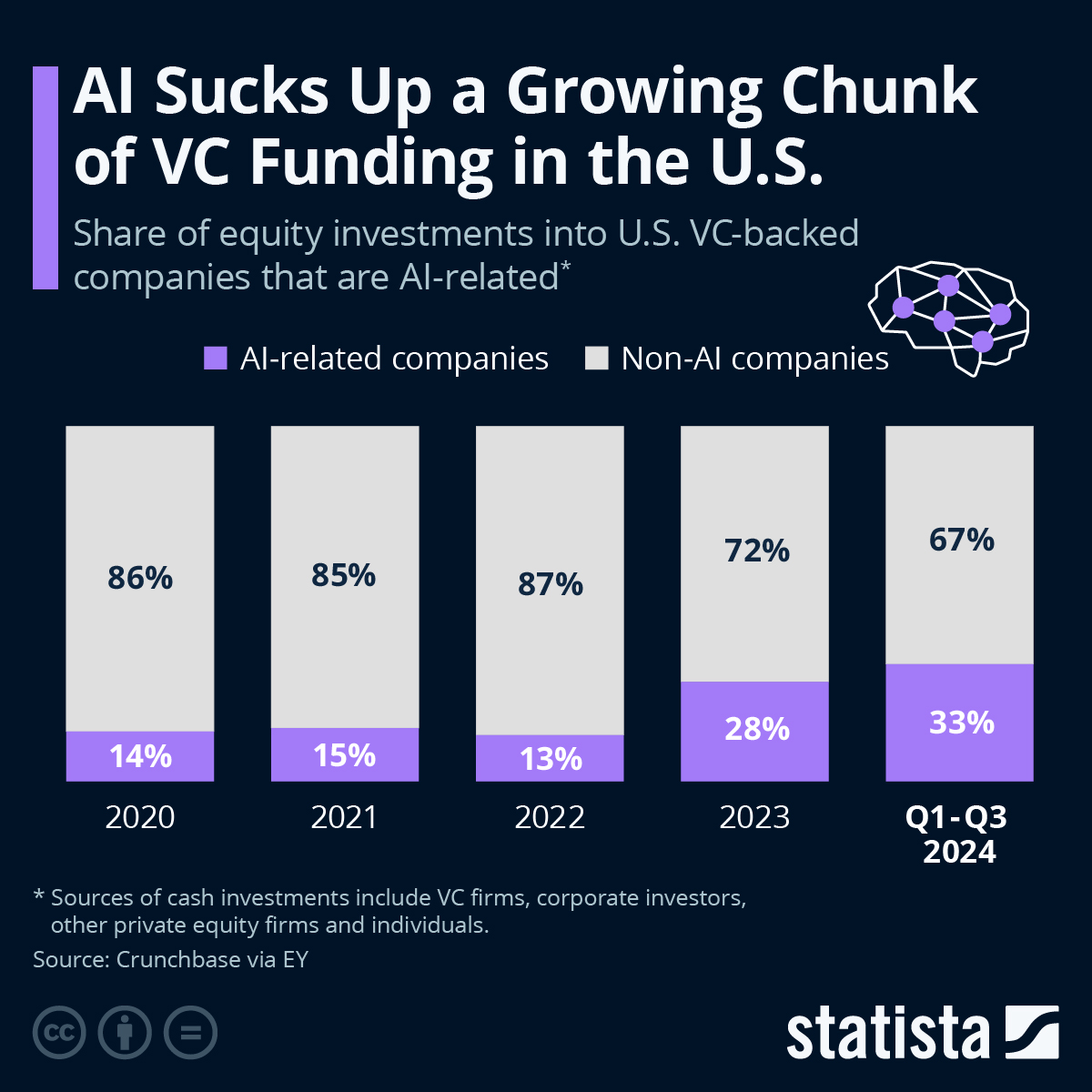
As Statista’s Felix Richter shows in the chart below, AI has sucked up an increasingly large chunk of VC funding in the United States in recent years.

Infographic: AI Sucks Up a Growing Chunk of VC Funding in the U.S. | Statista

In the first nine months of 2024, AI-related investments accounted for 33 percent of total investments into VC-backed companies headquartered in the U.S. That’s up from 14 percent in 2020 and could go even higher in the years ahead.

According to Crunchbase data analyzed by EY, AI deals accounted for 37 percent of the $38 billion raised by VC-backed companies in Q3 2024, with four of the 10 largest deals involving AI-related companies.

The latest increase in AI-related investments is still expected to be just the beginning of a longer-term trend.

As EY notes in its latest report on VC investments, most of the funds funneled into the field are currently focused on building the foundation for the technology, e.g. developing and training AI models.

Once this wave of investment ebbs, entrepreneurs will need to figure out ways to actually utilize the potential of AI, which will likely kick off a second wave of AI investments.

Loading…

Google-backed Anthropic debuts its most powerful chatbot yet, as generative AI battle heats up

From CNBC:

  • Anthropic on Monday debuted Claude 3, a chatbot and suite of AI models that it calls its fastest and most powerful yet.
  • The company, founded by ex-OpenAI research executives, has backers including Google, Salesforce and Amazon, and closed five different funding deals over the past year, totaling about $7.3 billion.
  • The new chatbot has the ability to summarize up to about 200,000 words, or a lengthy book, compared to ChatGPT’s ability to summarize about 3,000. Anthropic is also allowing image and document uploads for the first time.

Anthropic on Monday debuted Claude 3, a suite of artificial intelligence models that it says are its fastest and most powerful yet. The new tools are called Claude 3 Opus, Sonnet and Haiku.

The company said the most capable of the new models, Claude 3 Opus, outperformed OpenAI’s GPT-4 and Google’s Gemini Ultra on industry benchmark tests, such as undergraduate level knowledge, graduate level reasoning and basic mathematics.

This is the first time Anthropic has offered multimodal support. Users can upload photos, charts, documents and other types of unstructured data for analysis and answers.

The other models, Sonnet and Haiku, are more compact and less expensive than Opus. Sonnet and Opus are available in 159 countries starting Monday, while Haiku will be coming soon, according to Anthropic. The company declined to specify how long it took to train Claude 3 or how much it cost, but it said companies like Airtable and Asana helped A/B test the models.

This time last year, Anthropic was seen as a promising generative AI startup founded by ex-OpenAI research executives. It had completed Series A and B funding rounds, but it had only rolled out the first version of its chatbot without any consumer access or major fanfare.

Twelve months later, it’s one of the hottest AI startups, with backers including Google, Salesforce and Amazon, and a product that directly competes with ChatGPT in both the enterprise and consumer worlds. Over the past year, the startup closed five different funding deals, totaling about $7.3 billion.

The generative AI field has exploded over the past year, with a record $29.1 billion invested across nearly 700 deals in 2023, a more than 260% increase in deal value from a year earlier, according to PitchBook. It’s become the buzziest phrase on corporate earnings calls quarter after quarter. Academics and ethicists have voiced significant concerns about the technology’s tendency to propagate bias, but even so, it’s quickly made its way into schools, online travel, the medical industry, online advertising and more.

Between 60 and 80 people worked on the core AI model, while between 120 and 150 people worked on its technical aspects, Anthropic co-founder Daniela Amodei told CNBC in an interview. For the AI model’s last iteration, a team of 30 to 35 people worked directly on it, with about 150 people total supporting it, Amodei told CNBC in July.

Anthropic said Claude 3 can summarize up to about 150,00 words, or a sizeable book (think: around the length range of “Moby Dick” or “Harry Potter and the Deathly Hallows”). Its previous version could only summarize 75,000 words. Users can input large data sets, and ask for summaries in the form of a memo, letter or story. ChatGPT, by contrast, can handle about 3,000 words.

Amodei also said Claude 3 has a better understanding of risk in responses than its previous version.

“In our quest to have a highly harmless model, Claude 2 would sometimes over-refuse,” Amodei told CNBC. “When somebody would kind of bump up against some of the spicier topics or the trust and safety guardrails, sometimes Claude 2 would trend a little bit conservative in responding to those questions.”

Claude 3 has a more nuanced understanding of prompts, according to Anthropic.

Multimodality, or adding options like photo and video capabilities to generative AI, whether uploading them yourself or creating them using an AI model, has quickly become one of the industry’s hottest use cases.

“The world is multimodal,” OpenAI COO Brad Lightcap told CNBC in November. “If you think about the way we as humans process the world and engage with the world, we see things, we hear things, we say things — the world is much bigger than text. So to us, it always felt incomplete for text and code to be the single modalities, the single interfaces that we could have to how powerful these models are and what they can do.”

But multimodality, and increasingly complex AI models, also lead to more potential risks. Google recently took its AI image generator, part of its Gemini chatbot, offline after users discovered historical inaccuracies and questionable responses, which have circulated widely on social media.

Anthropic’s Claude 3 does not generate images; instead, it only allows users to upload images and other documents for analysis.

“Of course no model is perfect, and I think that’s a very important thing to say upfront,” Amodei told CNBC. “We’ve tried very diligently to make these models the intersection of as capable and as safe as possible. Of course there are going to be places where the model still makes something up from time to time.”

Clarification: Anthropic clarified with CNBC that Claude 3 can summarize about 150,000 words, not 200,000.

Get access to Anthropic and more –

Sign up for Venture Capital Cross Portal

Open AI Alternatives – Dataminr, Cerebras, Jasper, Cohere, Scale AI

Venture Capital Cross  — 11/24/2023  With the implosion of Open AI last week, investors are scrambling for alternatives.  Some funds have held back on Open AI capital contributions for secondary market transactions, according to sources.  Some have speculated that the collapse was more than an internal power struggle, that the technology was the issue.  Whatever is the case, there are hundreds of companies working on AI, Open AI is not the only one nor are they any kind of Monopoly.

Venture Capital broker-dealer Venture Capital Cross announces investment opportunities in hot AI names like Cohere, Jasper, Cerebras, Scale AI, Dataminr, and others.  In partnership with DT Unicorn Fund, Dataminr is available for accredited investors in sizes starting at $100,000 with a 0/20 SPV single layer structure.

Dataminr is an artificial intelligence company that provides AI based intelligence, alerts, and informational signals to it’s clients. The company’s private sector product, Dataminr Pulse, is used by corporations to monitor real-time events, and to aid with crisis response by providing playbooks, messaging tools and post-event documentation. Dataminr’s First Alert technology is used by first responders, such as those helping to provide aid during natural disasters and other emergency events. On the morning of January 5, 2021, Dataminr allegedly warned Capitol security officials of troubling online public chatter that would soon become the January 6 riot.

That’s definitely valuable, to some clients for sure.  Open AI’s revenue model is as yet unverified / unknown.  It may be groundbreaking, or it may be another FTX, we just don’t know.  Meanwhile, companies like Jasper AI have had their valuations cut back due to revenue decline, but they still have more revenues than Open AI and much higher revenue / valuation ratios.  So the question remains, do investors want to pickup companies like Jasper AI at discounts, or wait for the market to return and buy the high?  Until recently, it has been impossible to get AI companies at a discount to the last round.

Is this a time to buy in to the AI sector?  Some GPs think so.  VC Investment firms like Sequoia, Andreessen Horowitz, and SOMA Capital can’t get enough, according to Pitchbook.  But they have lots of capital, their economies of scale don’t necessarily apply to all investors.  Of course, there’s another way to play the AI sector – simply by Microsoft (MSFT).  Of course that’s a safer play, but you’re not going to get triple digit returns because for MSFT to double it takes a lot of news and revenue to move the needle at such a big Mega Cap.

There’s one drawback to many of these companies, however, they don’t transfer.  That means Jasper AI is forward only, and you need to be an ECP (Eligible Contract Participant) in order to buy OR sell a forward because they are derivative contracts not traded on an exchange.  The regulators look at them like swaps.

Cerebras Systems develops computing chips with the sole purpose of accelerating AI. The company is a startup backed by premier venture capitalists and the industry’s most successful technologists. (Crunchbase)

Cohere is a platform that gives developers and businesses access to NLP, powered by the innovative generation of large language models. Cohere is used to build machines that understand the world and make it safely accessible to all.  Cohere provides access to affordable, easy-to-deploy large language models. Its platform gives computers the ability to read and write. Whether to better understand what customers are saying or to write compelling copy that speaks to a target audience, Cohere can help. (Crunchbase)

Scale accelerates the development of AI applications by helping machine learning teams generate ground truth data. The company’s LiDAR, video, and image annotation APIs allow self-driving, drone, and robotics teams at companies like Lyft, OpenAI, Zoox, Pinterest, and Airbnb focus on building differentiated models vs. labeling data. (Crunchbase)

There are hundreds of other AI companies out there, and there’s space for many more.  Contrary to popular belief, AI isn’t destroying jobs, it’s creating them.  It’s also making workers more effective, so companies can pay them more.  It’s disproportionate, of course, if your job is a copy and paste type of job, AI may replace you, but it just means you should upgrade your skills and work in another department.  AI is not always automation, in most cases it’s not.  That means there will always be people who need to setup, run, control, organize, administer, support, sell, develop, train, brainstorm, deploy, the AI bots.  So don’t worry, this isn’t going to break the economy, it’s going to support it, and in parallel we’ll likely see a new disruptive paradigm of technology emerge…

Discover these investment opportunities and more @ VCCross.com or email invest@vccross.com or call (865) 328-7280

If you’re new to Private Markets, contact us for a free crash course on Venture Capital @ Udemy or the book Investors Guide to LEGAL Insider Trading.

DISCLAIMER: Investing is risky, only invest funds you can afford to lose.  Private Markets are for accredited investors only.  Forward contracts and other derivatives are for ECP Only.  Information displayed on this blog is for information and educational purposes only. Investing is extremely risky and investors even if they are accredited should only invest funds they can afford to lose. By viewing this site we are making no claims or recommending any investments, nor suggesting any course of investment action.  We are not recommending any investments or soliciting any action.